SUBNET ALLOCATION TOOL
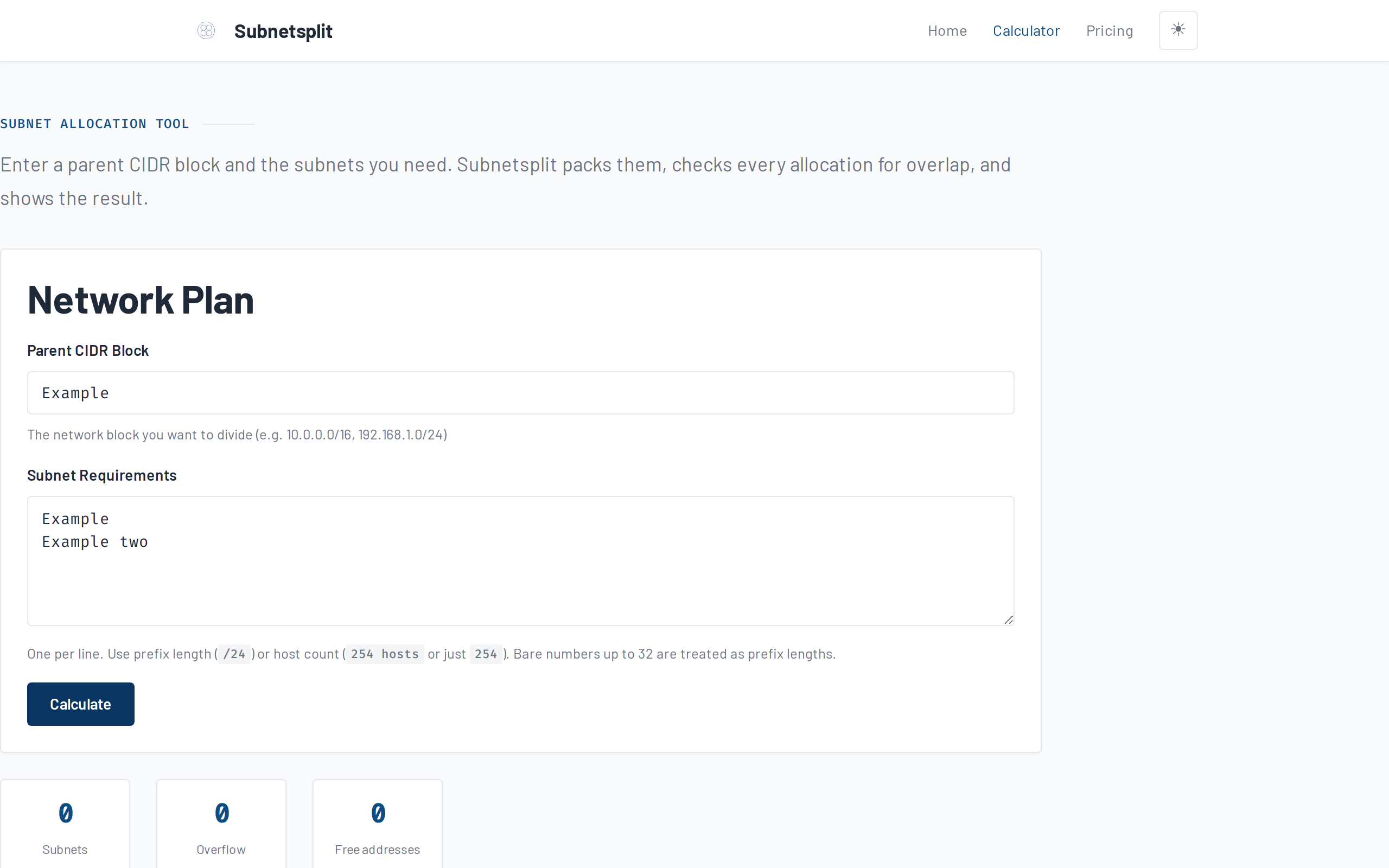
Feed Subnetsplit a CIDR block and the subnets you need. Every allocation is checked for overlap before you see the plan.
Subnetting is arithmetic nobody enjoys doing twice. The failure is never the math itself — it is an overlap nobody noticed, a block allocated twice, or a /26 written down where a /24 was meant. Subnetsplit packs subnets in order, checks every allocation against every other one, names the gaps, and lets you export the plan.
01 / SCOPE
An arithmetic engine for network engineers who allocate IP space and cannot afford an undiscovered overlap.
Subnetsplit is a client-side VLSM (Variable Length Subnet Mask) allocation planner. You give it a parent CIDR block — say 10.0.0.0/16 — and a list of subnets you need, by host count or by prefix length. It packs the largest subnets first, flags any request that will not fit, and names the remaining free space so you can see what is still available.
It is built for network engineers managing real IP allocations. Not a configuration tool, not a reachability scanner — just the arithmetic, checked and exported.
02 / OPERATION
Three inputs produce one verified plan.
-
Enter the parent block
A single CIDR range you want to divide, such as
10.0.0.0/16. Subnetsplit calculates the network address, broadcast address, subnet mask, and total usable hosts. -
List the subnets you need
One per line, by prefix length (
/24), by host count (254 hosts), or as a bare number — Subnetsplit accepts all three forms and translates each to the smallest prefix that fits. -
Review the verified plan
The allocation table shows every subnet's CIDR, network, broadcast, mask, usable count, and address range. Overlapping requests are flagged; remaining free space is reported. No upload, no server — the math happens in your browser.
03 / COST
The calculator is free. No account, no upload, no paywall.
Subnetsplit runs entirely in your browser — every line of CIDR arithmetic, every overlap check, every export. There is no server to pay for, no API credits to burn, no data that ever leaves your machine. The free tier is the whole product.
The calculator is and will remain free. No accounts, no servers, no hidden costs. See Pricing for the details.
04 / BOUNDARIES
It does not reach your network, configure a device, or store a plan.
- ● No network reachability checks. Subnetsplit has never opened a socket, sent a packet, or looked up a route over the wire. If you need to know whether an IP responds, this is not that tool.
- ● No device configuration. It does not push ACLs, set up DHCP scopes, or write router configs. The output is a plan you apply yourself.
- ● No accounts or sign-in. There are no user profiles, no session storage, no saved history. Every calculation starts from scratch when the page loads.
- ● No server-side storage. The allocation plan lives in the browser tab. Close the tab, and the plan is gone. Export it before you leave.
- ● No IPv6. The arithmetic works on 32-bit addresses only. IPv6 subnetting follows different rules and is not supported.
05 / VERIFICATION
Why trust the output when the plan matters.
- "How do I know the allocations do not overlap?" Every allocation is checked against every other one using a range-based overlap test. The source for this check is fewer than ten lines of JavaScript — readable, auditable, and in the repository.
- "What happens to the data I enter?" Nothing. The page contains no form submission, no analytics beacon, no network request. The CIDR arithmetic and the rendering happen in the same thread your browser runs. Closing the tab erases everything.
- "Can I use this in an air-gapped environment?" Yes. The page loads Google Fonts on first visit, but the tool itself — the HTML, CSS, and JavaScript — works fully offline after the initial load. The CIDR library is 420 lines of pure functions with zero external dependencies.
-
"Does it handle edge cases — /31 point-to-point links, /32 host routes?"
Yes.
/31returns 2 usable addresses per RFC 3021./32returns 1 usable address. The allocation engine packs subnets in ascending order of prefix length, so larger subnets (smaller masks) are placed first.
06 / OUTPUT
A table you can audit row by row.
Given a 10.0.0.0/16 parent and requirements of /24, /24, /26, /27, Subnetsplit produces this allocation table, with remaining free space named below it.
| CIDR | Network | Broadcast | Mask | Usable | Range |
|---|---|---|---|---|---|
10.0.0.0/24 | 10.0.0.0 | 10.0.0.255 | 255.255.255.0 | 254 | 10.0.0.0 – 10.0.0.255 |
10.0.1.0/24 | 10.0.1.0 | 10.0.1.255 | 255.255.255.0 | 254 | 10.0.1.0 – 10.0.1.255 |
10.0.2.0/26 | 10.0.2.0 | 10.0.2.63 | 255.255.255.192 | 62 | 10.0.2.0 – 10.0.2.63 |
10.0.2.64/27 | 10.0.2.64 | 10.0.2.95 | 255.255.255.224 | 30 | 10.0.2.64 – 10.0.2.95 |
Remaining gap: 10.0.2.96 – 10.0.255.255 (64,928 free addresses). The full plan can be reproduced in the tool.
07 / PRICING
Free. Forever. No hidden tiers.
The free tier is the whole calculator — no feature gating, no usage caps, no hidden costs. Everything the tool does is available immediately, with no account and no sign-up.
Free
- ✓ VLSM allocation from any parent CIDR
- ✓ Overlap verification on every allocation
- ✓ Remaining gap reporting
- ✓ Copy-as-text and CSV export
- ✓ Input by prefix or host count
- — Saved plans across sessions
- — Team workspaces
- — API access
SOMETHING TO TAKE WITH YOU
Feed Subnetsplit a CIDR block and the subnets you need. Get a verified plan in one click.
No upload, no sign-up, no server — just the arithmetic, checked and exported.
Open the calculator